Jules Laforgue 1883
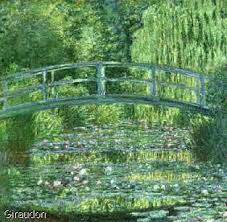
In a landscape bathed with light, in which entities are modelled as if in coloured grisaille, the academic painter sees nothing but white light spreading everywhere, whilst the impressionist sees it bathing everything not in dead whiteness, but in a thousand conflicting vibrations, in rich prismatic decompostitions of colour. Where the academic sees only lines at the edges of things, holding modelling in place, the impressionist sees real living lines, without geometric form, built from thousands of irregular touches which, at a distance, give the thing life. Where the academic sees only things down in regular, seperate positions within an armature of purely theoretical lines, the Impressionist sees perspective established by thousands of imperceptible tones and touches, by the variety of atmospheric states, with each plane not immobile but shifting.
...The Impressionist sees and renders nature as she is, which is to say solely by means of coloured vibrations. Neither drawing, nor light, nor modelling, nor perspective, nor chiaroscuro: these infantile classifications all resolve in reality into coloured vibrations, and must be obtained on the canvas solely by coloured vibrations.
In this small and limited exhibition at Gurlitt's, the formula is clearest in monet...and Pissarro...where everything is obtained by means of a thousand small touches, dancing off in all directions like so many straws of colour-each struggling for survival in the overall impression. No more isolated melodies, the whole thing is a symphony, which itself is life, living and changing, like the "forest voices" of Wagner's theories each struggling for existance in the great voice of the forest, just as the unconcious, the law of the world, is the great melodic voice resulting from the symphonyof conciousnesses of races and individuals. Such is the principle of the Impressionist school of plein air. And the eye of the master will be the one which will discern and render the keenest graduations and decompositions, and that on a simple flat canvas. This principle has been applied in France, not systematically but by men of genius, in poetry and in the novel.
The lectures on Impressionism to Post Impression really inspired me. I really wish I was more aware of the history of art at an earlier point because now I feel that I can appreciate art more knowing where its roots are. I also feel that I am more aware of the depths and allegories of art works. Now that I understand paintings more I have started painting and seeing things with a different eye. A lot of quotes have inspired me like the one above and :
Impressionists "develop their own originality." by abandoning themselves "to their personal sensations".
Cezanne said "To paint after nature is not a matter of copying the objective world, its giving shape to your sensations". Monet and Rouen did not want common sense conceptions or prejudices about how things ought to look to interfere with his personal impressions. Monet told Perry not to paint objects and events in the world but patches of colour, advising her: "When you go out to paint, try to forget what object you have before you. Merely think, this is a patch of blue, here an oblong of pink and to paint it just as it looks to you". Cezanne says " I see in stains" "see like a man who has just been born".
Cezanne also said "Treat nature by the cylinder, the sphere, the cone, everything in proper perspective so that each side of an object or a plane is directed towards a central point. Lines parallel to the horizon give breadth, that is a section of nature or, if you prefer, of the spectacle that the patter omnipotent: Acterne Deus spreads out before our eyes. Lines perpendicular to the horizon give depth. But nature for us men is more depth than surface when the need of introducing into our light vibrations, represented by reds and yellows, a sufficient amount of blue to give the impression of air".
Baudelaire's opinion of photography
This is an opinion that I find interesting as the topic has numerously crossed my mind. I believe that their is a truth in what he is saying but obviously when considering the use of photography in art today, it is not as applicable as photography has broadened into many fields of art especially when considering digital art and photo manipulation.
"An art of this type no longer created life, but merely reproduced it. It was this 'realistic' cult of nature which he was disturbed, its confusion with the beautiful, and the absence of dream and fantasy."
Photography was perceived as unfeeling, to be used by painters not as a model but as aide-memoir.
I've become more fascinated with drawing and painting:


